
Traditional Asset Performance Management (APM) focuses on optimizing the performance of physical assets throughout their lifecycle by leveraging data, digital models, advanced analytics, and machine learning. However, APM lacks real-time insights and a physics-based approach to address structural asset integrity.Structural Performance Management (SPM) is a systematic approach that ensures assets meet their intended function over their lifespan by continuously estimating, monitoring and analyzing critical parameters such as strain, stress and deflection. Akselos, a global leader in SPM, provides a real- time software solution that combines asset integrity and operational excellence. Their structural twin technology enhances asset performance, ensures uninterrupted operations, and extends asset life by understanding the equipment’s true operating integrity limits in near real-time. The SPM structural twin drives operational excellence and asset integrity in harmony.
LIMITATIONS OF TRADITIONAL ASSET PERFORMANCE MANAGEMENT
Asset Performance Management (APM), while not a new approach to managing assets, prioritizes achieving asset reliability and availability goals. APM aims to optimize the performance of physical assets across the asset life cycle, supporting connected maintenance and operations workers and maintaining a network of parts and services providers. APM prevents unplanned downtime by enhancing work processes to ensure assets run according to the intended design.
The focus of APM has been to incorporate real-time data and analytics into asset maintenance work processes and systems with much focus on rotating equipment. APM provides operational decision support through software enhanced with the data-rich industry-centric content and data needed for prescriptive compliance and proactive asset management throughout the complete asset lifecycle.
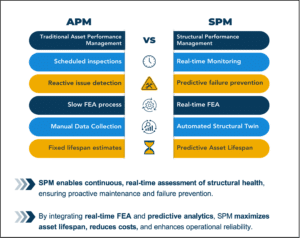
For asset-intensive industries, this needs to include structural integrity management systems. APM cannot provide real-time insights and an approach to physics-based structural asset integrity with a deep understanding of structural equipment health.
Ensuring structural asset integrity involves methods such as time-based inspections, risk-based inspections, and maintenance optimization, which are often empirical. When issues like cracks are detected, finite element analysis and root cause analysis are performed, but these processes can be time-consuming and reactive. Structural Performance Management (SPM) is a new class of products designed push the operating limits while extending equipment life and to fill the structural void in the APM technology stack and meet company sustainability business goals.
STRUCTURAL PERFORMANCE MANAGEMENT: A NEW CLASS OF APM
Regular inspections and assessments identify signs of deterioration, damage, or structural defects and typically involve visual inspections, non-destructive testing (NDT) techniques, and more in-depth structural evaluations. Manually collected data is analyzed to identify trends, anomalies, and potential risks to the structural integrity. Based on the collected data and analysis, the structure’s condition is assessed to determine its remaining service life and the need for maintenance or repair.
Condition-based inspections include a process to perform all the necessary Finite Element Analysis (FEA) calculations. FEA, while an effective strategy for design, has been too slow for operational use cases. Structural Performance Management (SPM) brings FEA from the design space into operations with the necessary speed to match decision- making and ensure compliance with standard engineering practices.
Structural performance management (SPM) is a systematic approach to ensuring that assets meet the intended function over their lifespan and align with sustainability objectives. It involves continuously monitoring and analyzing a structure to identify potential problems early on and take corrective action to prevent failure. Continuous monitoring of an on-line digital twin of critical parameters, such as strain, stress, deflection, is essential to track the behavior of the asset under different loading conditions. This is achieved using real- time sensors in an API-compliant asset model.
AKSELOS STRUCTURAL PERFORMANCE MANAGEMENT SOLUTION
Akselos SPM creates a structural twin for SPM by combining real-time operational data with asset integrity to Enhance asset performance, Ensure uninterrupted operations, and Extend asset life. This approach is called the “three E’s,” which aims to safely operate the asset with maximum output for the longest time possible and at minimum cost.
When considering enhancing asset performance, it’s important to note that this doesn’t involve redesigning the physical aspects of equipment. Instead, it focuses on uncovering hidden operating capacity within existing equipment. Conservative integrity operating windows constrain the operational limits, which are rarely questioned. By understanding the true integrity limits of equipment in real-time—considering factors like load, pressure, and temperature based on current conditions, including corrosion and fouling—it’s possible to expand the operating envelope safely and in compliance with industry standards. This means pushing the equipment to its true safe operating limits, thereby enhancing performance without compromising safety. The Akselos digital twin can extend asset life by completing a full FEA analysis in near real-time and calculates the stress and strain across the entire asset in high-fidelity (down to the millimetre level).
Asset owners benefit from SPM by:
Understanding how operating conditions consume asset life allows for informed trade-offs on decisions to run assets and equipment harder by pushing the operating envelope or running them conservatively until the next turnaround.
The Akselos SPM software provides advanced structural twins. The model is entirely based on the laws of physics and uses a detailed structural 3D model, real-time process data such as temperatures and pressures together in context with the operational data and integrity data such as inspection data, maintenance and repair data and corrosion data in a single view, in real-time, and with high fidelity. The physics-based model simulates the structural health of the asset in near real-time and identifies potential hotspots (creep, strength and fatigue), remaining life of individual components as well as other relevant structural information.
These assessments conform to the rigorous standards of API 579-1 for fitness-for-service. The simulation results are displayed on a user-friendly web dashboard and seamlessly integrated into existing infrastructure via standardized APIs.